

Decision hooks
A decision hook asks a plugin of yours whether to accept something before the server accepts it. The plugin answers with a verdict from a fixed list. It never rewrites anything and it takes no action on an account: the most it can do is stop one post, follow, sign-up, upload, or profile change, or file a report for your moderators. People decide what happens to an account.
Nothing is reviewed by default. A server with no hook address makes no call and spends no time on them. This version keeps
the records, the modes, and the admin screens described here. Of the intake paths, posts from other servers ask
inbound.status, follows from other servers ask inbound.follow, sign-ups ask signup.check, uploads ask
media.check, posts of local accounts ask local.status, profiles of accounts on other servers ask inbound.actor, and
profile changes of local accounts ask local.profile; the other hooks are not called yet.
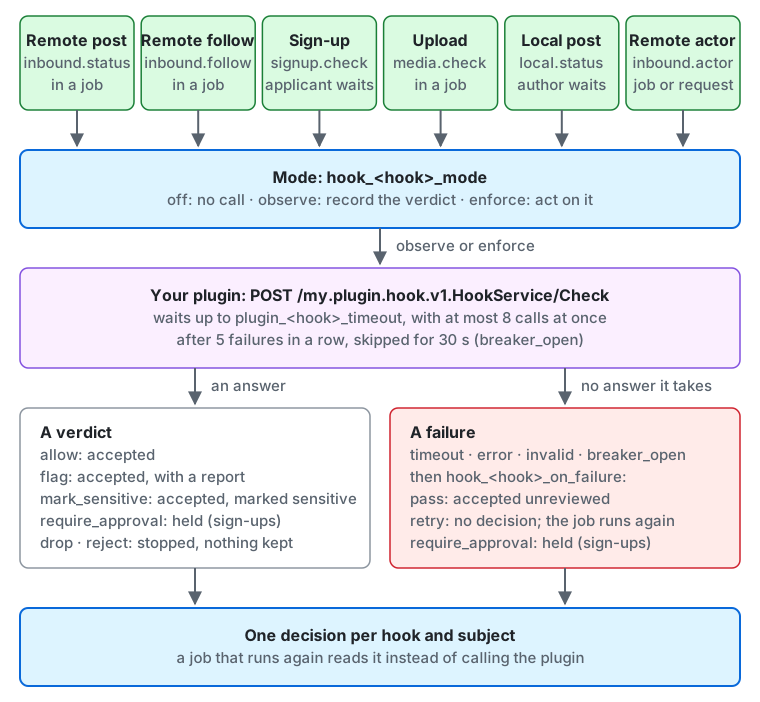
From the top of the diagram down:
- What is reviewed, and who waits. A post from another server (
inbound.status), a follow from another server (inbound.follow), and an upload (media.check) are reviewed in a job. A sign-up (signup.check) is reviewed while the applicant waits, a post of a local account (local.status) while its author waits, and a change of a local account’s profile (local.profile) while its owner waits. A profile from another server (inbound.actor) is reviewed wherever the server fetches the account: in a job, and also while a request waits, such as one from a server whose account is new here. - The mode,
hook_<hook>_mode:offmakes no call,observerecords the verdict and acts on nothing, andenforceacts on it (Modes). - Your plugin gets
POST /my.plugin.hook.v1.HookService/Check. The server waits up toplugin_<hook>_timeout, makes at most 8 calls at once, and after 5 failures in a row skips the plugin for 30 seconds (breaker_open). - A verdict:
allowaccepts the subject,flagaccepts it and files a report,mark_sensitiveaccepts it marked as sensitive,require_approvalholds a sign-up, anddropandrejectstop it and keep nothing (a sign-up’srejectonly withhook_signup_check_reject). A failure is atimeout, anerror, aninvalidanswer, orbreaker_open, and an answer the hook does not take counts as one. When the hook enforces,hook_<hook>_on_failuredecides:passaccepts the subject unreviewed,retryrecords no decision and runs the job again, andrequire_approvalholds a sign-up (When the plugin fails). - One decision per hook and subject is recorded, and a job that runs again reads it instead of calling the plugin (The decisions).
The hooks
Section titled “The hooks”| Hook | What it reviews | What it can answer | When the plugin fails |
|---|---|---|---|
inbound.status |
Posts from other servers | allow, drop, flag, mark_sensitive |
pass (default) or retry |
inbound.follow |
Follows from other servers | allow, drop, flag |
pass (default) or retry |
signup.check |
Sign-ups, after the CAPTCHA and the block list | allow, require_approval, reject |
pass (default) or require_approval |
media.check |
Uploaded media, before anyone can use them | allow, mark_sensitive, flag, reject |
pass (default) or retry |
local.status |
Posts of local accounts, and their edits | allow, flag, reject |
pass |
inbound.actor |
Profiles of accounts on other servers, when they change | allow, drop, flag |
pass (default) or retry |
local.profile |
Profile changes of local accounts | allow, flag, reject |
pass |
Set plugin_<hook>_address to give a hook a plugin, with a dot in the name becoming _
(plugin_inbound_status_address). Plugins covers the destination, its authentication, and how to test a
plugin with my plugin test --kind inbound.status <address>. The call is POST /my.plugin.hook.v1.HookService/Check.
What each answer does:
dropstops the subject and stores nothing of it. Oninbound.actorit keeps the profile stored before (below). A wrongdropsilently hides a post from its followers too, so read what a hook would drop inobservebefore you enforce it.flaglets it through and files one report per decision. Oninbound.followthe report is about the account that sent the follow, names no post, and is filed once the follow is recorded; its reporter, category, and comment are those of a post’s report. Oninbound.actorthe report is about the account whose profile it is, in the same way.mark_sensitivelets it through and shows its attachments as sensitive until a moderator cancels the decision.require_approvalholds the sign-up for approval.rejectrefuses it, with fixed text that shows nothing of the plugin’s answer. Onsignup.checkthis also takes the setting below. Onmedia.checkit keeps nothing of the upload, the original included (below). Onlocal.statusits author can appeal. Onlocal.profilethe profile stays as it was and there is no appeal (below).
An answer can carry a coded reason (spam, harassment, sexual, violence, illegal, malware, other) and a note of
up to 200 characters for your moderators. An answer the hook does not take counts as a failure.
What inbound.status reviews
Section titled “What inbound.status reviews”The server asks about each Create of a post and each Update of one that it would take in, before it stores anything. Every
revision is its own subject with its own decision.
- A post is asked about only when it is related to a local account: a local account follows its author, it names a local
account, or it is in a thread with a local post. Whether a local account follows the author does not narrow it further:
the plugin gets
any_local_followerand can weigh it. A post only a relay brought in is never asked about, nor is anUpdateof a stored post that no longer relates to a local account: its revision is stored without a question. - A direct post from an author no local account follows is not sent unless you turn on
hook_inbound_status_unfollowed_direct. Posts of your local accounts are never sent, at any setting. - Polls’ votes, deletions, undos, likes, reactions, and boosts are never asked about, so stopping a plugin cannot stop a deletion from arriving. A thread fetch or a boost’s fetch can still bring in the same post another way.
What each answer does to a post:
dropon aCreatestores nothing and creates no notification or timeline entry, and a redelivery is ignored as a duplicate.dropon anUpdatemakes no revision and keeps the previous one. A dropped post is not stored, so anUpdateof it published within the last day is taken as a new post: the plugin is asked again about that revision, as about any other one, and its answer to the earlierCreatedoes not carry over.flagfiles one report per decision, with your instance actor as the reporter, the reason’s category (spamandmalwareas Spam,illegalas Legal,harassment,sexual, andviolenceas Violation, and anything else as Other), and the plugin’s note as the comment. The report says that a review filed it. It is not forwarded to the author’s server unless a moderator forwards it, and a forward never sends the note: only the text the moderator writes then. Resolving it notifies nobody. Each decision files its own report, so a wave of spam can fill the queue.mark_sensitivemarks the post, not the revision: the mark stays on later revisions, whatever they are answered, until a moderator cancels the decision. It shows attachments as sensitive and leaves the text alone, so a post with no attachment looks no different, and other servers do not see it.
What media.check reviews
Section titled “What media.check reviews”The server asks about each file a local account uploads, for any use: an attachment, an avatar, a header, or a custom emoji. It asks once, when the file is first processed and before it is ready, so nobody can use it while the plugin decides. Using the same file for something else later reads the decision already made. Remote media is never asked about.
It sends the smallest image the server made of the file, without its metadata, and never the original: for a video or
audio file, the small image of its poster or embedded cover, or no image when there is none. With it go what the file
is for, whether it is an image, video, or audio, its size, how long it plays, and whether it moves. The alt text and
anything of the account or of a post are not sent. The message MediaSubject of the HookService protocol has the fields.
What each answer does to an upload:
rejectmakes the processing fail, as for a file the server cannot read: the uploader sees that the file could not be processed, and a post cannot attach it. The server keeps nothing of a rejected file. It deletes the original once processing ends, whatever the answer, and a rejected file gets no processed version. If you must preserve such files, or report them to someone, your plugin has to do it when it answers: the server cannot give the file back. Cancelling arejectonly changes its record.mark_sensitivemarks the post that attaches the file, in the transaction that creates the post or the edit that adds the file, and the mark stays until a moderator cancels the decision, as forinbound.status. An avatar, a header, or an emoji has no post, so the decision is only recorded.flagfiles one report per decision, with your instance actor as the reporter. For an attachment it is filed with the post that attaches the file and points at that post; a file that is never posted files none. For an avatar, a header, or an emoji it is filed when the file is processed, about the account that uploaded it.
The processing job waits for the plugin for up to plugin_media_check_timeout (10 seconds by default). Adding a custom
emoji from another server or approving an emoji request processes the image while the moderator waits, so that wait
is theirs.
Sign-ups
Section titled “Sign-ups”signup.check runs on sign-ups from the registration page and through a login provider, after the CAPTCHA and the
sign-up block list, so a request either of them refuses never reaches the plugin. A sign-up with an
invite code never calls it. It sends the email address the applicant entered and the client’s IP address; the account does
not exist yet, so the key of the subject is the ID the account would get, and an applicant who tries again is a new subject.
The answers act as the block list’s do when the hook enforces:
require_approvalleaves the sign-up waiting under Moderation > Registrations, as a block with the same severity does, in every registration mode. Approve or reject it there: cancelling the decision does not change the registration.rejectdoes nothing until you turn onhook_signup_check_reject(Server settings > External review, off by default). While it is off, arejectis recorded inobserve, since it stops nothing, and the sign-up goes on. While it is on, the applicant sees the same fixed text as for a block (“This server cannot accept this sign-up.”). No account is written, so cancelling such a decision only changes its record, and the applicant signs up again.
Applicants never see the reason or the note of a decision.
The applicant’s request waits for the plugin for up to plugin_signup_check_timeout (2 seconds by default; keep it short, as
a person is waiting). The wait is not part of a database transaction. A sign-up that later fails, such as for a taken
username, keeps its decision until the retention removes it.
Profiles from other servers
Section titled “Profiles from other servers”inbound.actor reviews the profile of an account on another server where the server takes it in: the first time it fetches
the account, when the account sends an Update of itself, and when the server fetches it again, as it does for the accounts
your users follow once a day. It asks only when the profile differs from the one stored, so fetching an account again with
the same profile makes no call. The profile it reviews is:
- the display name, as plain text,
- the bio and the profile fields, as the server stores them (sanitized HTML),
- the addresses of the avatar and the header image on the other server. The server sends no image.
The plugin also gets the account’s address, its server, its username, and whether the account is new to your server. The
key of a decision is the account’s address, #, and a digest of the profile, so each distinct profile gets one decision, and
the same profile sent again reads it.
What the verdicts do:
dropkeeps the profile stored before: the display name, the bio, the fields, the avatar, the header, and their custom emoji stay as they were. The server still stores the rest of what it received: the account’s keys, its inbox and other addresses, its username, and whether it is locked, a bot, discoverable, and indexable. Without the keys and addresses the server could neither verify the account’s activities nor deliver to it, and the locked and indexable settings say how to follow the account and whether its owner allows indexing. While the profile stays dropped, fetching it again reads the same decision and keeps the stored one.- An account fetched for the first time is always stored, because follows and mentions need it, so its
dropis taken for aflag: the profile is stored and a report is filed. The decision still showsdrop. flagstores the profile and files one report on the account per decision.
When the plugin fails, pass stores the profile unreviewed, and the server does not ask about it again until it changes.
With retry, the server does not store an account whose profile changed while the plugin fails: an Update waits in its
job, which holds back the other activities of that account as for inbound.status, and a fetch
made while a request waits fails, so a server whose account is new here has its delivery refused until the plugin is back
and sends it again.
Cancelling a drop of inbound.actor fetches the account again from its server, which stores the profile it serves now
without calling the plugin when it is the dropped one, and asks about it when it changed since.
Local posts
Section titled “Local posts”local.status reviews a post of an account on your server before the server creates it, and each edit of one before the
server stores it. The author waits for the plugin, so
the wait is short: plugin_local_status_timeout (1 second by default). A failure, a timeout, or an open breaker always lets the
post through (pass is its only failure behaviour), and the wait is not part of a database transaction.
What it sends and when:
- Only the posts of accounts younger than
hook_local_status_account_age_days(Server settings > External review, 7 days by default;0sends the posts of every account). New accounts are where most spam comes from, and established accounts are not sent. - Only
public,local, andunlistedposts.privateanddirectposts are never sent. - The text as the author typed it and as the server renders it, the content warning, the language, whether it is marked sensitive, the image descriptions, the poll options, the hashtags, how many accounts it mentions, the address the post would get, the post it replies to or quotes (by address only), the author’s address and username, and when the account was created. No media is sent.
- The key of the subject is the ID the post would get. Sending a post again with the same
Idempotency-Keyreturns the post that was created, without calling the plugin; a new attempt is a new subject. - An edit is sent the same way, with the post as edited, to the same accounts: those inside
hook_local_status_account_age_days. Its key is the post’s ID,#, and the ID of the new revision, so each edit is a subject of its own. - Starting a voice chat room posts its first post without this hook.
When it enforces, reject refuses the post and nothing is stored. The author sees fixed text (“This post was not published.”)
and a way to appeal; never the reason or the note. flag lets the post through and files one report of it, against its
author.
On an edit, reject refuses that edit alone: the post stays as it was, and the author sees fixed text (“This edit was not
saved.”). An edit cannot be appealed, since the post is still there for your moderators to act on as usual. flag stores the
edit and files a report of the post, and allow lets it through.
Appeals
Section titled “Appeals”The author of a refused post can appeal it within appeal_window_days (the same window as for moderation actions), once per
decision. The appeal carries the text of the post, since the server stored nothing of it, and an optional comment for your
moderators. No plugin is called.
Your moderators (manage_reports) are notified of each new appeal (Appeals of refused posts in their notification
settings, which they can also get by email; the notification opens the appeal), and review appeals under Moderation >
Automated reviews > Appeals of refused posts. Each appeal opens on its own page, with the text the author sent:
- Uphold leaves the decision as it is, and goes in the audit log as
hook_appeal_upheld. - Overturn cancels the decision, which goes in the audit log as
hook_decision_overridden, and stops sending the account’s posts tolocal.status, in one transaction. The refused post is not restored: the author posts it again.
Either way the author is notified of the outcome, among the notices from the moderators, and the post form shows it under
the refusal. The notification and the form say only whether the decision stays or was cancelled, never the reason or the
note. A first-party client reads where an appeal stands with GET /api/v1/hook_decisions/{id}/appeal.
An account that an overturned appeal took out of the hook stays out of it until the account is deleted. If it is later taken
over, local.status no longer reviews it.
Local profiles
Section titled “Local profiles”local.profile reviews a change of the profile of an account on your server before the server stores it. The owner waits
for the plugin, so the wait is short: plugin_local_profile_timeout (1 second by default). A failure, a timeout, or an open
breaker always lets the change through (pass is its only failure behaviour), and the wait is not part of a database
transaction.
What it sends and when:
- Only the changes of accounts younger than
hook_local_profile_account_age_days(Server settings > External review, 7 days by default;0sends those of every account). - Only a change of what the hook sees: the display name, the bio, the profile fields, the avatar, or the header. A change that only locks the account or changes its discovery settings is not sent.
- The display name, the bio as typed and as the server renders it, each profile field’s name and value (as typed and as rendered), whether the change sets, replaces, or removes the avatar or the header, the account’s address and username, and when the account was created. No image is sent. The profile is public, so the hook may use plain TCP.
- The key of the subject is the account’s ID,
#, and the ID of the profile revision the change would store, so each change is a subject of its own.
When it enforces, reject refuses that change alone: the profile stays as it was, and the owner sees fixed text (“This
change of your profile was not saved.”), never the reason or the note. There is no appeal: the owner can change the profile
and save it again. flag saves the change and files one report against the account, which names no post; its reporter,
category, and comment are those of a post’s report.
Each hook has a mode, an instance setting (hook_inbound_status_mode and so on) you change under
Server settings > External review, which offers enforce only once the mode is not off. Changes go in the audit
log as setting_changed.
| Mode | What it does |
|---|---|
off |
Calls nothing. |
observe |
Records the verdict and acts on nothing. This is the default of every hook. |
enforce |
Acts on the verdict. |
A hook goes from off to enforce only through observe.
When the plugin fails
Section titled “When the plugin fails”A timeout, an error, and an invalid answer are recorded as outcomes of their own (timeout, error, invalid), never as
verdicts. After 5 failed calls in a row the server skips the plugin for 30 seconds and then tries one call, so an outage
costs each subject no wait; a skipped call is recorded as breaker_open. Each server process counts by itself.
What happens to the subject then depends on hook_<hook>_on_failure:
passlets it through unreviewed. Spam can get in during an outage, but nothing else stops. This is the default.retryfails the job, which runs again and calls the plugin again, and records no decision. Jobs from one actor run in order, so everything later from that actor waits meanwhile, deletions included, for up to about 4 hours and 15 minutes. After its last run the job becomes a dead job, which releases the others.require_approvalholds the sign-up for a moderator.
For media.check, pass makes the file ready unreviewed. retry holds the upload as still processing until the plugin
answers or the job runs out of runs; the file is never ready meanwhile, and a dead job leaves it unprocessed, which the
cleanup of unattached uploads then deletes. No other job waits for it.
Each process makes at most 8 calls of a plugin at once, and a call that waits its turn past the hook’s deadline counts as a
timeout. Waits show in my.plugin.slot_wait (Running). Keep plugin_inbound_status_timeout short: while a call
waits, later jobs from the same actor wait with it.
In observe a failure never holds anything up. Moderators get a notification once a day per hook when its calls keep failing.
The metrics are my.hook.decisions, my.hook.failures, and my.hook.duration (Running).
The decisions
Section titled “The decisions”The server records one decision per hook and subject, so a job that runs again reads it and does not call the plugin again. A decision holds the hook, the key of the subject, the mode, the outcome, the reason, the note, and how long the call took. It holds no text of a post, no email address, and no IP address.
Moderation > Automated reviews (manage_reports) shows the counts and waits of the last 7 days, and what the hooks
stopped, would have stopped in observe, or could not check. Each decision opens on its own page with its reason, note, and
wait. Cancelling a decision, from the list or its page, goes in the audit log as hook_decision_overridden. A reject of local.status is not cancelled there: its author appeals it.
What cancelling does depends on the answer. A mark_sensitive loses its mark, and a mark from a moderation action on the same
post stays. A flag keeps its report, which you resolve as usual. A drop of inbound.status processes the received post
again without asking the plugin, for as long as the server keeps the activity it received (7 days); after that, the screen
says so and cancelling only records the cancellation.
Cancelling a drop of inbound.follow runs the follow again, without calling the plugin, for as long as the server keeps
the activity it received (7 days). After that the follow cannot come back and the cancellation only goes on record; the
other server has to send a new follow.
A follow only asks the hook when it would be recorded as a new follow or follow request. Taking a follow back (Undo) never
asks, and neither does a follow that the server refuses anyway: one that the federation mode refuses, one of a moved or
deactivated account, one of the instance actor, or one between accounts that block each other, which gets its rejection as
usual. A follow sent again for a follow or request that already exists does not ask either: the server answers it as usual,
and accepts it again when the follow is already accepted. A dropped follow gets no answer, so the other server keeps showing
it as requested. Sending the same activity again is ignored as a duplicate.
An automated effect goes in the audit log, with the system as the actor, only when it leaves state: mark_sensitive, a
filed flag, and require_approval (hook_decision_applied). drop and reject store nothing, so they stay in the
decisions alone.
The job hook.purge_decisions removes decisions after hook_decisions_retention_days days (default 90, at least 30). It keeps
those that a sensitive mark on an existing post rests on, those of an account under a
retention hold, and each reject of a new post by local.status its author can
still appeal or whose appeal waits for review. A reject of an edit cannot be appealed, so it goes once the retention period
is over. An appeal goes with its decision. Deleting an account removes its decisions, its appeals, and
its exemption from local.status.
What you tell your users
Section titled “What you tell your users”While a hook has a plugin and is not off, your information page (/about) states that an external review is in use, what
it covers, and what is sent to it. The server writes this from your settings, including the account age of
hook_local_status_account_age_days and hook_local_profile_account_age_days (or that those of every account go, at
0) and whether
hook_inbound_status_unfollowed_direct sends the direct posts of authors nobody here follows.
What is sent, and what it costs
Section titled “What is sent, and what it costs”Calls, their cost, and sent data grow with the volume the server receives, on inbound.status above all: every post in scope
is one call, and every revision another. Review what you send before you turn a hook on:
inbound.statusandlocal.statussend the text of posts, and refuse plain TCP, on loopback too.inbound.statussends what the remote server sent: the text in each of its languages, the content warning, whether it is marked sensitive, when it was published, the post’s address and URL, the address of the post it replies to, the addresses and descriptions of attachments (no media), poll options, hashtags, the author and the author’s server, the visibility, and how many accounts the post names and how many of them are local. It also sends whether a local account follows the author (any_local_follower), which is data about your users. Followers-only (private) posts are sent like public ones, and direct posts as above. It sends nothing of the post it replies to but its address.local.statussends the fields listed under Local posts. The messageInboundStatusof theHookServiceprotocol has the fields.signup.checksends the email address and the IP address of each applicant, and refuses plain TCP.inbound.followsends the two parties of a follow.inbound.actorsends the public profile of an account on another server, as listed under Profiles from other servers, and may use plain TCP. It is called whenever such a profile changes, so its volume follows the number of accounts your server knows.media.checksends the smallest processed image of each upload, never the original, with what the file is for, its kind, size, and length. It may use plain TCP, as it sends no text: a processed image can still show a person.local.profilesends the public profile listed under Local profiles, and no image. It may use plain TCP.
For LLMs and coding agents:this page as Markdown, llms.txt,llms-full.txt, llms-small.txt