

The event stream
このコンテンツはまだ日本語訳がありません。
The server pushes new posts, notifications, direct messages, and announcements as Server-Sent Events (text/event-stream), so a client need not poll.
| Endpoint | Scopes | Events |
|---|---|---|
GET /api/v1/streaming |
read:statuses and read:notifications |
The user’s home and list timelines, notifications, conversations of the direct messages (with read:direct), and announcements. |
GET /api/v1/streaming/timelines/{timeline} |
read:statuses |
New posts (update only) of the local or federated timeline. |
Open a stream with fetch and the Authorization: Bearer header, like any other call. The browser’s EventSource cannot send the header, so it cannot be used.
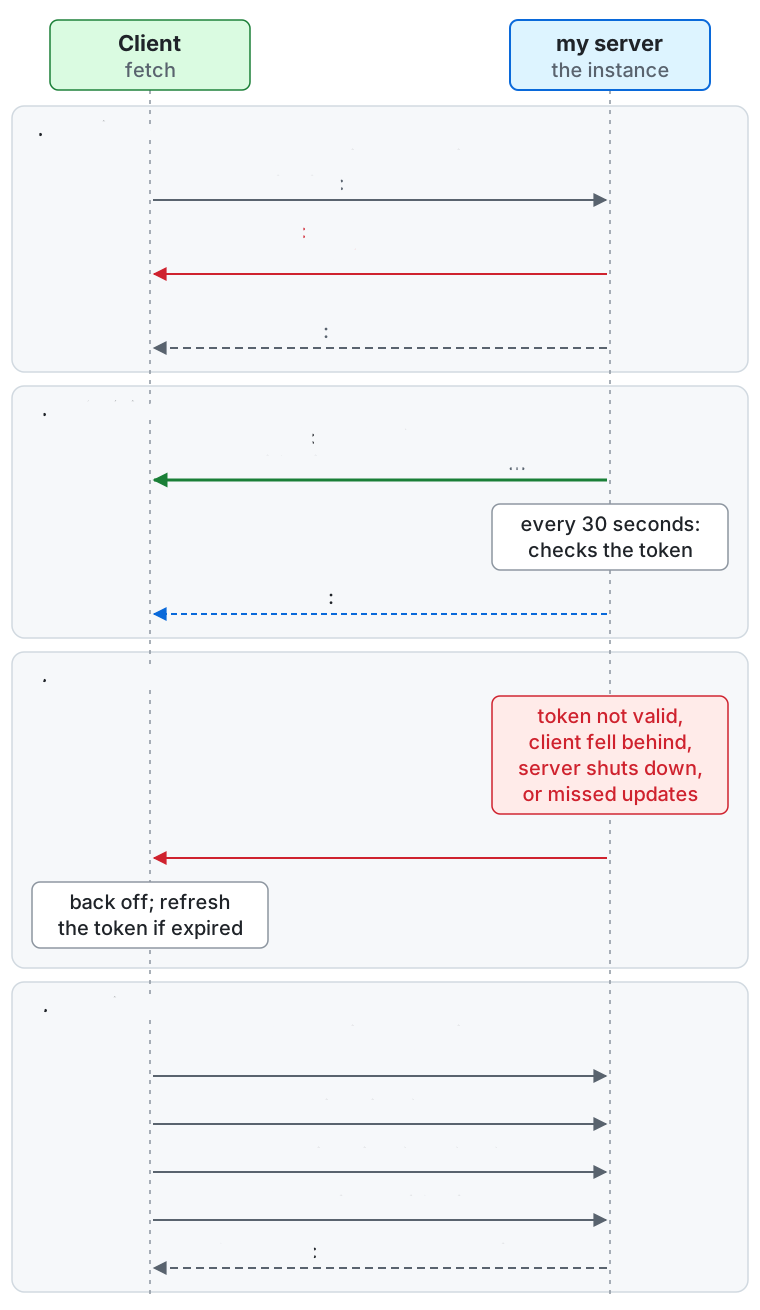
From the top of the diagram down, between the client and the server:
- Opening a stream. The client sends
GET /api/v1/streamingwithAuthorization: Bearer <access_token>. The server refuses with429(/api/v1/problems/too-many-streams) or with503andRetry-After, or answers200withtext/event-streamand the comment line: connected. - While it is open. The server sends events (
update,list_update,notification,announcement, …). Every 30 seconds it checks the access token again and sends the comment line: heartbeat. - The stream ends when the token is no longer valid, the client fell behind, the server shuts down, or the server may have missed updates. The client backs off, and refreshes the token if it expired.
- Catching up. The client opens a new stream with
GET /api/v1/streaming, then reads what the stream missed from the first pages ofGET /api/v1/timelines/home,GET /api/v1/timelines/list/{id},GET /api/v1/conversationsandGET /api/v1/notifications: the server replays nothing.
Events of /api/v1/streaming
Section titled “Events of /api/v1/streaming”| Event | data |
|---|---|
update |
A Status: a new post or boost in the home timeline, as it would appear there. |
list_update |
{"list_id": "...", "status": {...}}: the same post, once for each of the user’s lists that shows it, right after its update. |
notification |
A Notification. A notification that the user’s notification policy filters into a notification request sends none. |
notification_requests |
A NotificationRequestSummary, as GET /api/v1/notifications/requests/summary shows it: the counts of the notification requests changed, because a notification was filtered into one or one was accepted or dismissed. |
notifications_read |
A NotificationsRead: the user read notifications on a device, this one or another. last_read_id and unread_count are the marker and the count as GET /api/v1/notifications/marker shows them now, and id, when present, is a notification read on its own (POST /api/v1/notifications/{id}/read): show it as read. |
conversation |
A Conversation, as GET /api/v1/conversations shows it: a direct post the user sent or received arrived in it, or the user read it on a device. A token without read:direct receives none, and a conversation that the user hid receives none until a newer post arrives. |
announcement |
An Announcement that was published or changed. |
announcement_removed |
{"id": "..."}: an announcement no longer shows. |
delete |
{"id": "..."}: a status that the user may see was deleted by its author, a moderator, or its server. Remove it, and the boosts of it, wherever they show. The timeline streams send it too, for the statuses of their timeline. |
The user’s keyword filters apply to the events as to the timelines and notifications they come from: a post that a filter with the action hide matches is never sent, nor is its notification, and a post that only warn filters match arrives with them in its filtered.
The server sends a comment line (: heartbeat) every 30 seconds. Ignore events you do not know: new ones can appear (stability).
Staying connected
Section titled “Staying connected”- The server replays nothing. After a stream ends, reconnect and read what you missed with ordinary requests: the first page of the home timeline, of the open list timelines (or of the local or federated timeline for those streams), the conversations, and the notifications. Announcements whose window starts later arrive with no event; list them from time to time.
- The server ends a stream when the access token stops being valid, when the client does not keep up, when the server shuts down, and when it may have missed updates. A timeline stream also ends, and then answers
404, while the instance turns that timeline off. Reconnect with a backoff, and with a refreshed token if the old one expired. 429with the type/api/v1/problems/too-many-streams: the user already holds as many streams open as the server allows. Close one.503withRetry-After: the server cannot receive updates now. Retry after that many seconds.- Other
4xxanswers (a401that a refresh did not cure, a403for a missing scope) will not change by retrying: fix the cause. - A proxy that buffers responses breaks a stream. Where you cannot avoid one, read the notifications and the timelines with ordinary requests instead.
- On an instance that runs several server processes without a shared stream broker, a stream may miss updates. The operator can tell you which your instance uses.
The client libraries implement the reconnecting for you.
LLM とコーディングエージェント向け:llms.txt,llms-full.txt, llms-small.txt